
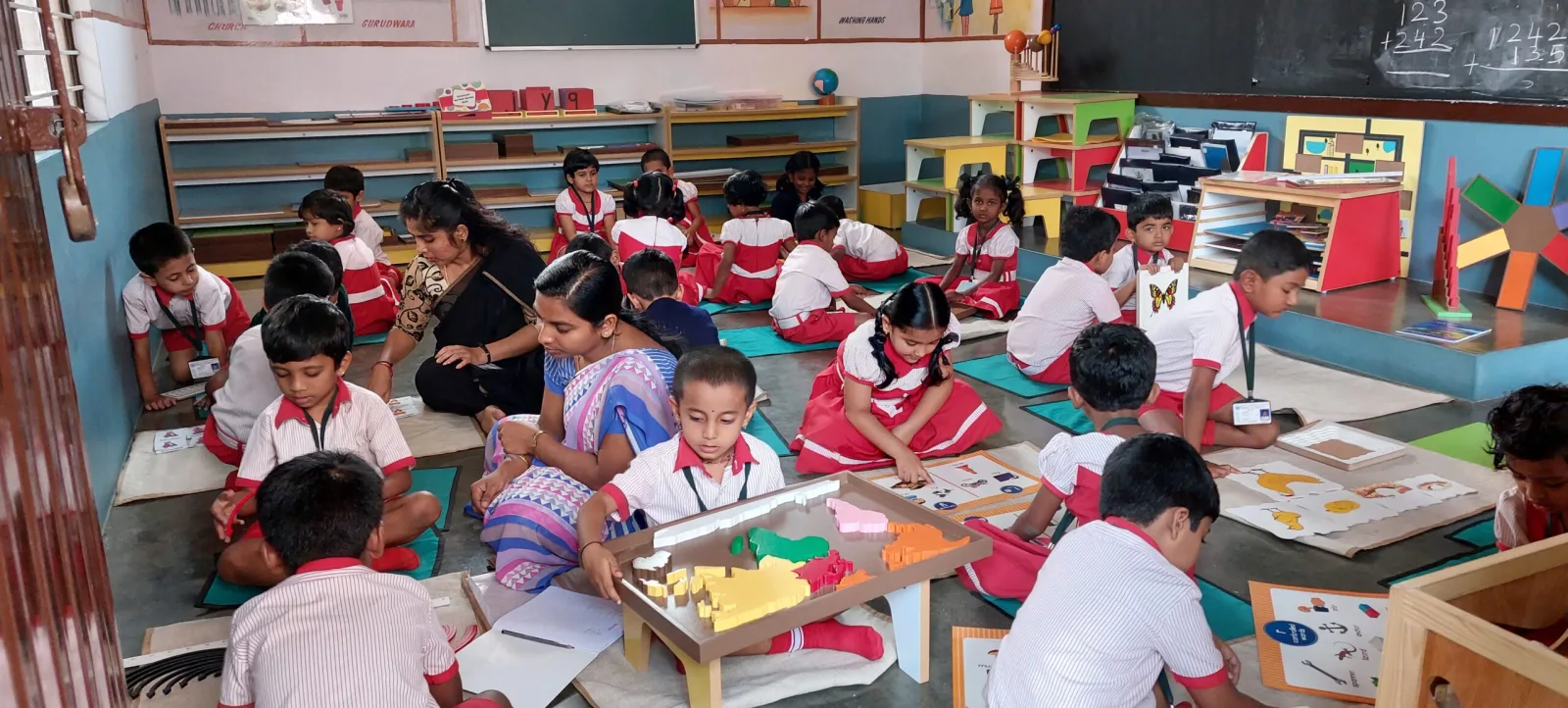
The Montessori Lab at Apollo Public School: How Hands-On Learning Works in the Nursery Wing
What a Montessori Lab is, what children do in it, and how hands-on learning supports young children at Apollo Public School's Nursery Wing in Sunkadakatte, Bengaluru.
23 October 2026
Walk into most nursery classrooms and you will find the usual things: colourful walls, songs, a teacher at the front. Look into Apollo Public School’s Montessori Lab and what stands out is that the children are not waiting to be told what to do. They are seated on mats, working with hands-on materials while a teacher stays close by. For parents trying to picture what the early years at a school actually look like, that picture says more than a brochure can.
What a Montessori Lab Is
At Apollo, the Montessori Lab is a dedicated space in the Nursery Wing where children work with interactive, hands-on materials. The idea behind it is simple: very young children learn best by doing. Instead of listening to an explanation and repeating it, they pick something up, move it, sort it, build with it and work out for themselves how it behaves.
The materials are designed to develop cognitive and motor skills together. A child who is sorting, matching or building is using small hand movements, concentration and early reasoning all at once, which is exactly what the Nursery years are for.
Why Hands-On Learning Suits Ages 3 to 6
The Nursery Wing at Apollo is for children between 3 and 6, an age at which most children cannot yet learn from a page and have limited patience for sitting still. What they have is curiosity, and a need to touch and try things.
Hands-on work meets them where they are. It lets a child go at their own pace, repeat something they enjoy until it clicks, and feel the satisfaction of finishing a task unaided. That matters more than it sounds: a child who learns early that they can figure things out tends to approach new situations with confidence rather than anxiety.
Fostering Curiosity and Independence
The school describes the Montessori Lab as a place that fosters curiosity and independence, and these two go together. Curiosity is what gets a child started; independence is what keeps them going when something is difficult.
In a Montessori-style classroom, that typically looks like a child choosing a material, working through it at their own pace, and then putting it back, with a teacher close by but not doing the task for them. For parents, it is often the first time they see their child concentrate on something for an unbroken stretch of time.
How It Fits With the Rest of the Nursery Day
The Montessori Lab is one part of a broader programme. The Nursery Wing also builds gross motor skills and early mathematical concepts through activities, develops language and vocabulary alongside listening skills, and uses audio-visual smart classes to keep lessons lively. Every class has a personal “mother-teacher” who connects with parents to share how each child is doing.
Put together, a child’s day mixes movement, language, early number work, audio-visual lessons and quiet, focused, hands-on time. No single method is asked to do everything.
Beyond the Lab
Hands-on learning is not limited to one room. The Nursery Wing has its own playground, where children build physical ability, social skills and creativity through active play, and well-equipped classrooms where lessons are interactive and attention is personal. Special activities are also held every second and fourth Saturday, giving children more varied things to try and parents a window into what the school day involves.
What to Look for When You Visit
If you are comparing nursery options, the Montessori question is not really “does the school use the word?” It is “what are the children actually doing?” A few things are worth watching for:
- Are the children busy and engaged, or waiting for the next instruction?
- Is the material within reach? Children cannot choose what they cannot get to.
- Is the teacher guiding or taking over? Good early-years teaching often looks quiet from the outside.
- Do the children look calm? A well-run hands-on room usually has a settled hum, not chaos.
The best way to judge any of this is to see it. A campus visit lets you watch a session, ask questions and see how your own child responds to the space.
Where This Leads
The Nursery Wing is the first stage of a school journey that continues into the Primary Wing, where Abacus and Karate begin, and on to High School and the State Board SSLC. If you are still deciding when your child should start, we have written about how to choose the right starting age for Nursery, and about what to check when choosing a State Board school in Sunkadakatte.
Explore the Nursery Wing at Apollo →
To see the Montessori Lab for yourself, read about the admission process or get in touch to arrange a visit to our Sunkadakatte campus.
See the full Nursery Wing program page
Explore Nursery Wing