
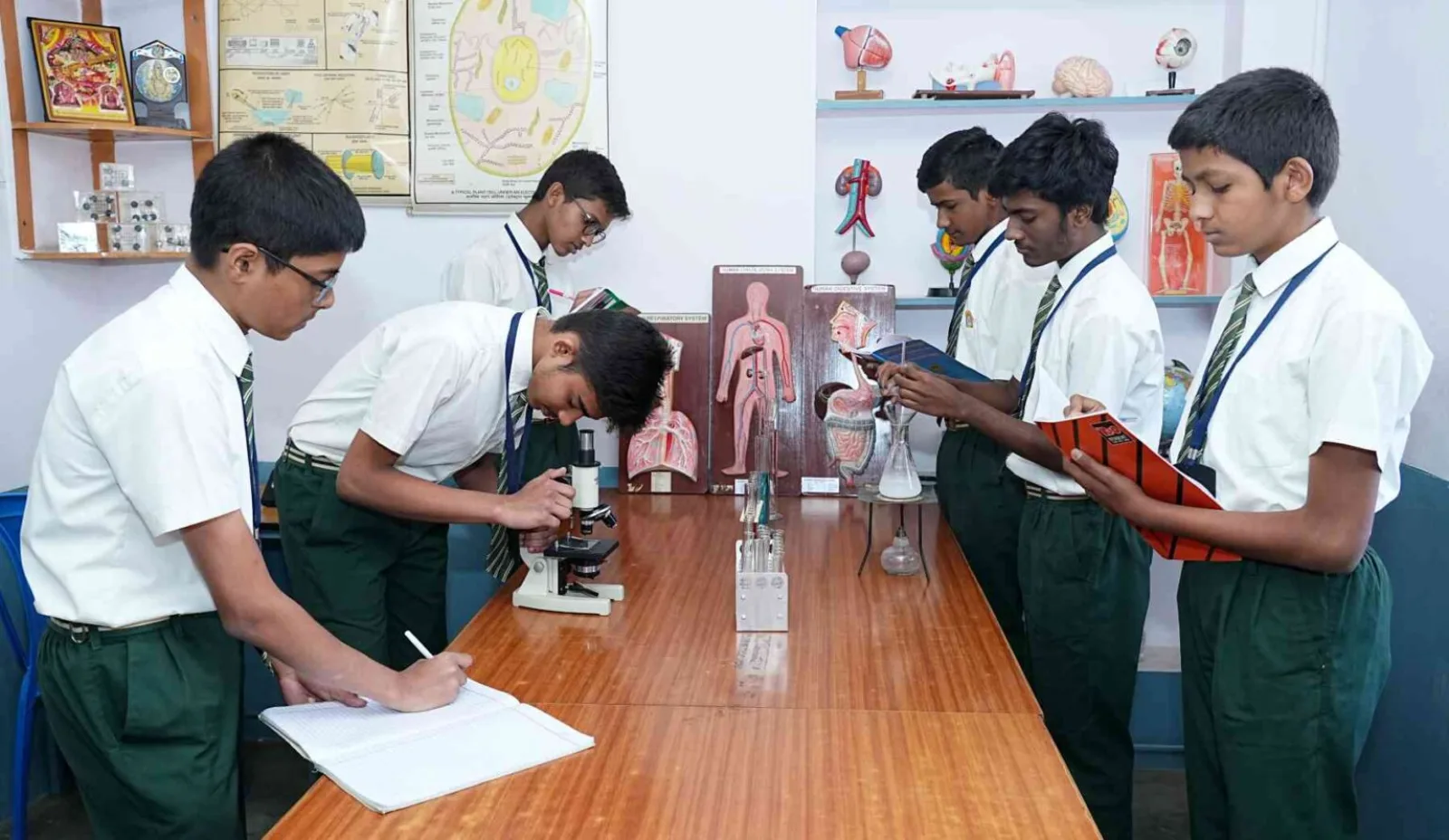
How Apollo's High School Prepares Students for the SSLC
How the High School wing at Apollo Public School, Sunkadakatte, prepares ages 11 to 16 for the SSLC: term appraisals, remedial support, Mind Maps, home timetables and Vedic Maths.
13 November 2026
For most families in Karnataka, the SSLC at the end of Class 10 is the first board examination that really counts, and the years leading up to it shape how a student approaches it. Parents choosing a High School in Sunkadakatte are often weighing two things: how the school prepares students for the exam, and how it keeps them, and the family, informed along the way. Here is how the High School wing at Apollo Public School goes about it.
A Wing Built Around Preparation, Not Just Teaching
Apollo’s High School wing is for students aged 11 to 16 and follows the State Board (SSLC) curriculum in English medium. The wing describes its goal as preparing students to tackle competitive exams with confidence, while keeping values such as honesty, sincerity and a competitive spirit at the centre of how they learn. It also stresses that parents should be kept informed and involved in their child’s education, which is why much of the structure below is designed to make progress visible.
If you are still comparing boards and schools, our guide to choosing a State Board school in Sunkadakatte explains how the SSLC pathway works.
Term Appraisals and Performance Analysis
At the end of each term, students go through a thorough appraisal and performance analysis. The point is not only to record marks. The analysis identifies the areas where a student needs to improve, and the results are shared with parents so they get useful feedback on their child’s progress.
What happens next matters just as much. Apollo provides remedial support after each term to help close learning gaps. A learning gap rarely fixes itself, and catching it at the end of a term, rather than in the final months before the SSLC, gives a student time to recover.
Individualised Attention
Teachers at Apollo get to know each student personally, so guidance and feedback are tailored to the individual rather than delivered to the class as a whole. For a student who is quiet in class or quietly falling behind, that personal knowledge is often what makes the difference between a gap being noticed or missed. If you are visiting the school, ask how this works in practice for the class your child will join.
Mind Maps and Chapter Timelines
Students use Mind Maps and timelines for each chapter. These give a clear, complete overview of a chapter’s concepts on a single page, which makes revision faster and helps students see how ideas connect instead of memorising them as separate facts. For subjects with a lot of content, such as Social Science and Science, a good one-page summary made earlier in the year is far more useful than a rush of notes just before the exam.
Structured Home Timetables
Preparation does not stop when the school day ends. Apollo gives students well-structured home timetables to help them organise their study time. Many students lose marks not because they do not know the material but because their time is not planned. A timetable that is built into the school’s routine makes homework and revision a habit rather than a negotiation at home.
Vedic Maths From Class 6 to Class 9
In the High School years, students also take Vedic Maths in Classes 6 to 9: faster, more efficient calculation methods that make maths less daunting and build genuine number confidence. It follows on from Abacus in the Primary Wing, and we have explained how Abacus and Vedic Maths fit together in a separate post.
What the SSLC 2026 Batch Achieved
The school’s published SSLC Results 2026 graphic shows how its students performed. Pooja KH topped the batch with 621 marks (99.36%), followed closely by Hemashree H with 619 (99.04%). In the batch, 85 students achieved Distinction, 54 achieved First Class and 8 achieved Second Class. You can see the full announcement in our gallery.
Results vary from batch to batch and from child to child, so treat them as one piece of information, not a promise. They are best read alongside what you see for yourself: how classes run, how teachers talk to students, and how the school communicates with parents.
Questions to Ask When You Visit
- How often are students assessed, and what happens with the results? Look for analysis and follow-up, not only a report card.
- What support is there for a student who is falling behind? Ask specifically about remedial help.
- How do teachers track individual students? Ask for an example.
- How are parents kept informed? Ask how frequently, and in what form.
Apollo’s admission office welcomes visits by appointment, and a guided campus tour is part of it. Our step-by-step guide to the admission process explains what happens at each stage, including the written test for Classes 9 and 10.
Explore the High School wing at Apollo →
You can also read about the admission process or get in touch to arrange a visit to our Sunkadakatte campus.
See the full High School program page
Explore High School